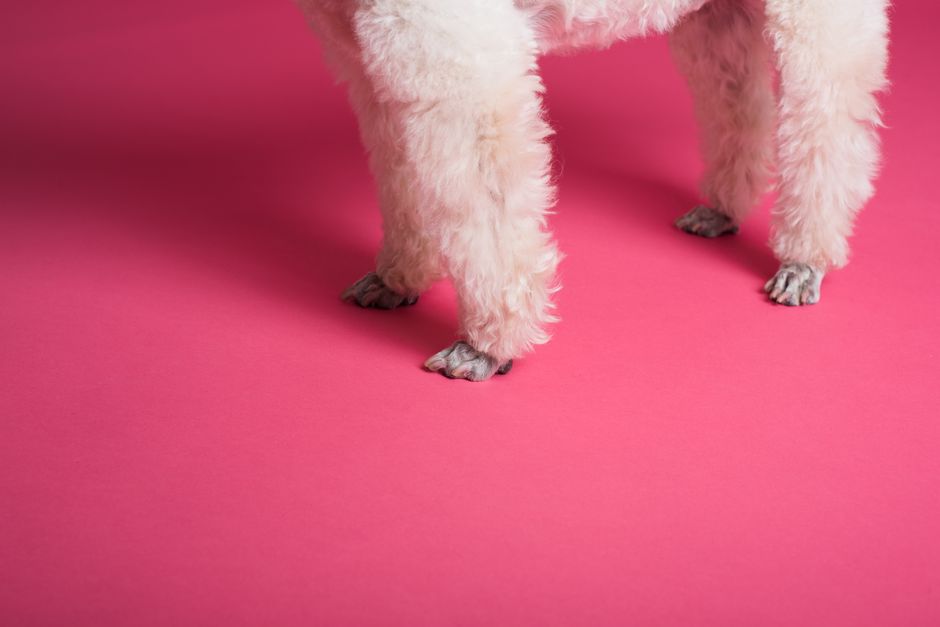
On a large, heavy dog, overgrown nails are not a cosmetic problem. A nail is only the right length when the dog stands naturally and the nails do not touch the floor. Once they do, the dog has to change how it stands and walks to cope, and on a 30 kilo dog that small change compounds into real strain.
The mechanics are simple once you picture them. When a long nail hits the ground it acts like a lever, pushing the toe up and back with every step. To stay comfortable the dog rocks its weight backward off the toes, which rolls the whole leg out of its natural alignment. Hold that posture for months and the load lands on joints that were never meant to carry it: the toes first, then the wrists, then the elbows and shoulders, and eventually the hips and spine as the dog compensates further up the chain. The bigger the dog, the heavier that misplaced load.
You often see the result before you connect it to the nails. A dog that suddenly hates slick floors, splays its feet, walks gingerly, or seems to be stiffening with age may simply have sore feet from nails that are too long, and owners blame the years when the real culprit is a trim that never came often enough. Long nails are also far more likely to snag, split, or tear, ripping down into the living tissue, which is painful and bleeds a great deal.
Here is the part that changes how you should trim. Inside every nail is the quick, the living core of blood vessel and nerve, and it grows outward as the nail grows, so neglected nails are genuinely hard to shorten without nicking it. The good news: trim little and often and the quick steadily recedes back up the nail, letting you keep the nails short for good. A grinder makes those frequent, tiny trims painless, because it shaves a sliver at a time instead of taking one risky bite.
How often you need to do it depends on your dog's life, not the calendar. Roads and pavement file nails down naturally, so a dog walked daily on hard surfaces needs less. A dog that pads about on grass, carpet and soft trails barely wears them at all and will creep long quickly. The simplest tells that you have left it too long: you can hear the nails clicking on a hard floor, you can see them touching the ground when the dog stands square, or the toes start to splay to take the pressure off.
Meet the quick: the one thing every trim is really about
Almost everything about safe nail care comes down to one structure: the quick. It is the bundle of blood vessel and nerve that runs down the centre of each nail, and it is what you are working to avoid. Cut or grind into it and it hurts and bleeds, which is exactly the experience that turns a relaxed dog into one that fights every future trim. Read the nail well and you never have to.
The quick is not fixed in place. It tracks the nail, extending as the nail grows long and retreating as you keep the tip short. That single fact is the whole strategy for bringing overgrown nails back: you cannot lop them to a perfect length in one go, but if you take a little off and keep the end blunt, the quick withdraws over the following week or two and gives you room to take a little more. Grinding suits this perfectly, because removing fractions of a millimetre at a time is how you creep up on a receding quick without ever crossing it.
Reading where the quick is
Light, translucent nails
On clear or pale nails the quick shows through as a pink core. Trim or grind up to a couple of millimetres short of where the pink begins and you stay safely clear. These are the easy ones.
Dark or black nails
You cannot see the quick through a black nail, so you read the cut surface instead. As you grind, the freshly exposed end changes from a rough, chalky ring to a smoother, slightly moist-looking surface. That smoother look means you are getting close.
The tell-tale dot
On any nail, the moment a small grey or black dot appears in the centre of the freshly ground tip, stop. That dot is the leading edge of the quick showing just beneath the surface. It is your signal that this nail is done for today.
First decide: grind, clip, or let a groomer do it
Before you compare grinders, be honest about whether grinding is even the right tool for your dog right now. There are three sensible routes, and the best one depends on your dog's nails and temperament more than on any product.
Grinder
Thick or black nails, you want smooth rounded edges, and your dog can be desensitized to a little noise and vibration
Best for most large dogs
Clippers
Light-colored nails where you can see the quick, you want fast trims, and your dog hates vibration and sound more than pressure
Fine, but risks splitting thick nails
Groomer or vet
Severe fear, badly overgrown nails, a dog with a history of being quicked, or you are simply not confident yet
Use until you have trained at home
Grinder vs clipper: when each one actually wins
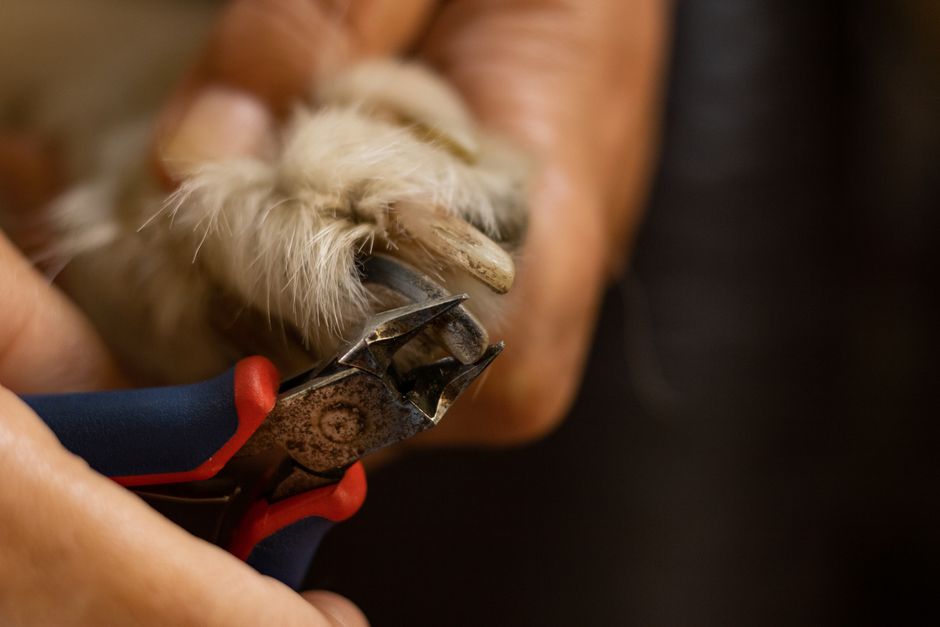
This is not a turf war. Clippers and grinders solve the same job in different ways, and plenty of owners use both: clip the bulk length off, then grind to shape and smooth. Knowing when each tool has the edge is what keeps trims fast and bloodless.
When a grinder wins
Grinders remove tiny amounts at a time, so you can creep right up to the quick and stop the instant you see the warning dot. That makes them the safer choice on black nails, on dense large-breed nails, and any time you are bringing badly overgrown nails back gradually. They also leave a smooth, rounded edge that will not scratch floors, snag on bedding, or scratch you on the sofa.
When clippers win
On pale nails where the quick is easy to see, a good clipper is faster and silent. If your dog tolerates a quick pinch but loathes vibration, heat and sound, clippers may genuinely stress them less. They are also unbeatable for taking a lot of length off quickly before you switch to a grinder to finish.
The real risk: quicking
A clipper takes a whole chunk in one cut, so a single misjudgement on a dark nail can hit the quick and end the session in blood and fear. A grinder shaves fractions, giving you several chances to read the nail and back off. If the thing you fear most is hurting your dog, the grinder's slow, reversible bite is reassuring.
Why grinding suits black and thick nails
You cannot see the quick on a black nail, so the only safe approach is to take a little and read the surface, which is exactly how a grinder works. Thick, dense nails that a clipper can crush or split apart grind down cleanly and evenly, without the lengthwise cracking that big nails are prone to.
Why grinding suits anxious dogs
There is no sudden crack and no pinch with a grinder, which removes the startle that sets some dogs off. The catch is honest: you trade the pinch for noise and vibration, so a sound-sensitive dog needs the desensitization plan below before the grinder is genuinely the calmer option. For many owners the easiest routine is both, clipping the length down then grinding to round and smooth the edges.
What actually matters in a grinder for a large dog
Torque, not just speed
Big dogs have dense nails, and a weak motor bogs down and drags the moment it meets resistance, which both slows you down and scares the dog. Torque is the ability to keep spinning under load, and it matters more than a high top speed. The Dremel 7760 has the most of it here; the Casfuy 6-Speed has plenty for most large dogs.
Noise and vibration
This is the number-one reason dogs refuse a grinder. A high-pitched whine or a buzzy handle sends a sensitive dog running before the tool ever touches a nail. For a nervous large dog, a quieter, lower-vibration model you can actually use beats a powerful one they bolt from, which is the whole case for the LuckyTail.
Battery vs corded, and runtime
Most pet grinders, including all four picks here, are cordless and recharge over USB, which is convenient and safe around a wriggling dog. The trade-off is runtime: a full set of giant-breed nails takes a while, so look for solid battery life and ideally USB-C charging. Corded rotary tools never run flat but tether you to a socket. The Casfuy's runtime is only average, so keep it topped up.
Port size and grit
Most pet grinders have a guarded opening, or port, that you press the nail into. It must be wide enough for a large dog's nail; tiny ports built for cats and toy breeds are useless here. Casfuy offers three port sizes including a large one. A coarser, durable grinding surface chews through thick nails faster than a fine one.
Guards and safety caps
A good guard does two jobs: it contains the dust and stops long fur being dragged into the spinning head, and it limits how far the nail can go in so you cannot over-grind in one slip. It should also sit comfortably in your hand, because you will hold the tool through forty-plus nails on a big dog, often at an awkward angle under a paw, and a clumsy barrel is how slips and burns happen.
Replaceable bands and bits
Grinding heads wear out. Some grinders use a bonded diamond bit that lasts a long time; others use replaceable sanding bands that you swap when they go smooth. Either is fine, but check that replacements are cheap and easy to find before you commit. Dremel parts in particular are stocked almost everywhere.
Photo: Goochie Poochie Grooming / Pexels
60-second router: which dog nail grinder for large dogs?
Answer three things and we point you to the right tool, not a top-10 list.
How does your dog react to noise?
What are the nails like?
Budget?
Your matchCasfuy 6-Speed
Because it is balanced power and noise for most large dogs.
Enough torque for thick nails, quiet enough that most dogs settle.
Power: Strong, 6 speedsNoise: Low to moderateUSB rechargeableThree ports incl. large
The sweet spot for big dogs: a strong-but-not-screaming motor, multiple speeds so you can start gentle and ramp up, and a port sized for large nails. If you do not know where to start, start here.
The six speeds matter more than they sound. You can run it slow and quiet during the first weeks of training, then speed up once your dog is relaxed, so the same tool grows with your dog's confidence instead of being outgrown. The three port sizes mean you can use the large opening for a mastiff's nails and a smaller one for the dewclaws.
On thick or dark nails it has the torque to keep moving without dragging, which is what stops a big dog flinching. It is not the quietest or the most powerful tool on this list, but it is the one that does most things well for most dogs, which is exactly what a default pick should be.
Pros
Strong on thick nails
Multiple speeds, quiet-ish
Large-nail port
Watch-outs
Battery life is average
One honest watch-out: Battery life is only average, so for a full set of giant-breed nails keep it charged or top it up between paws rather than starting on a half-empty cell.
The most torque here. Grinds dense nails fast, but it is louder.
When nails are so thick or dark that lesser grinders bog down, the Dremel powers through without dragging, which makes it the most capable tool here for giant breeds and stubborn black nails. It is a proper rotary tool from a brand that has made them for decades, so the build is solid and replacement sanding drums are stocked almost everywhere. The trade-off is noise and vibration: it is the buzziest pick, so it suits a calmer dog or one you have already taken through the desensitization plan below.
Highest torque
Handles the densest nails
Trusted brand, parts everywhere
Watch-out: It is noticeably louder and buzzier than the others, so a nervous dog needs the 7-day plan first or it will simply refuse to sit for it.
The low-noise, low-vibration pick for dogs that bolt at sound.
If your dog runs at the first whir, this is the one. It is engineered around low noise and gentle vibration, which for a fearful large dog is the difference between a tool they tolerate and one they refuse outright. It trades some raw power for that calm, so on very thick giant-breed nails you will work in patient passes rather than blasting through, but a grinder your dog sits still for always beats a stronger one that turns trims into a wrestling match.
Very low noise
Gentle vibration
Good for reactive dogs
Watch-out: It trades outright power for quiet, so on the densest giant-breed nails you will spend a little longer on each one.
A grinder plus clippers to learn on, at the lowest sensible price.
A low-risk way to start: you get a grinder and clippers together, a decent rechargeable battery, and three port sizes, so you can try both tools and learn what your dog prefers without overspending before you know they take to grinding at all. It is lighter-duty than the premium picks, so the densest giant-breed nails are not its strength, but for a first grinder, a puppy you are starting young, or a calmer dog it is genuinely good value and a sensible place to begin.
Affordable
Grinder plus clippers combo
Low-risk first buy
Watch-out: It is lighter-duty than the premium picks, so the densest giant-breed nails are not where it shines.
Once your dog tolerates the tool, the technique itself is simple. The golden rule is light and frequent beats deep and rare. Short passes, read the nail, and stop early.
Settle the dog first. A big dog feels safest lying down or sitting against you on a non-slip surface, and a helper to feed treats turns the whole thing into a calm routine rather than a restraint.
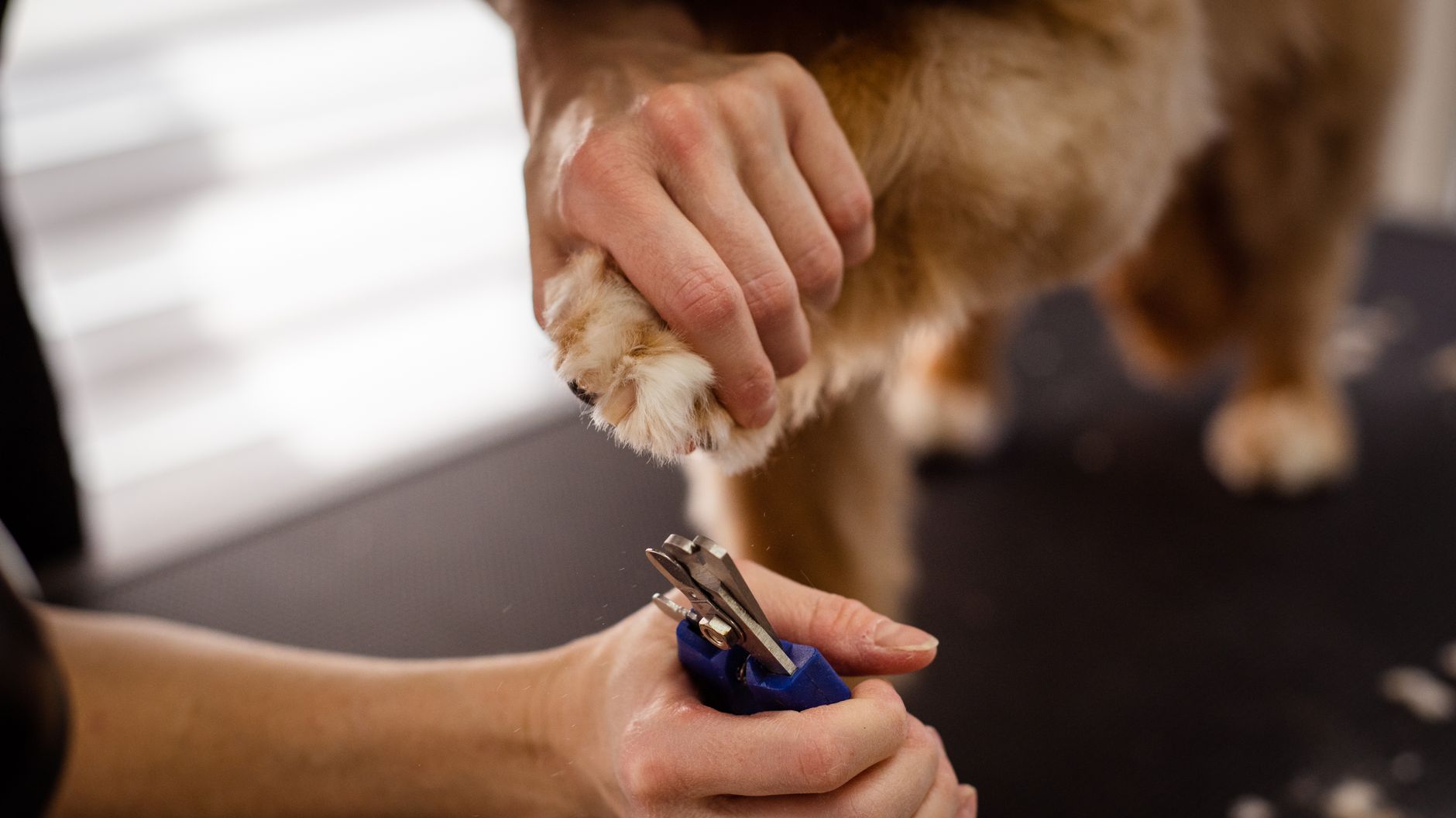
Hold the paw gently but securely and push the fur well back so nothing can wrap around the spinning head. Long feathering near the toes is the most common thing to get caught.
Touch the spinning band to the tip for one to two seconds, then lift off. Short passes only. Never lean in or hold it on one spot, because heat builds fast and a held grinder burns.
Work the underside and the tip to round the nail, moving from the point back toward the quick, not into it. Take the sharp corners off so the finished nail is smooth all the way round.
On dark nails, watch the cut surface and stop the instant a small grey or black dot appears in the centre. On pale nails, stop a couple of millimetres short of the pink.
Do not forget the dewclaws, the higher nails on the inside of the leg that never touch the ground and so never wear. They are often the longest and can curl into the pad.
Smooth the edges, reward immediately, and do a few nails at a time rather than all four paws in one sitting. Coming back tomorrow is always better than pushing a tired, fed-up dog.
Black nails feel intimidating but the method removes the guesswork: take a little, look, take a little, look. The freshly ground end starts chalky and grey, turns smoother and slightly glassy as you near the quick, and shows that central dot just before you would reach it. If you are ever unsure, stop. A slightly long nail you tidy again in three days is far better than a quicked one that sets your dog's training back weeks.
The 7-day plan to make grinding stress-free
A large dog that fears the tool is the real problem to solve, not the nails. Force it and you create a dog that fights every trim for life; take a week to build the association and you get a dog that offers a paw. The whole plan is built on counter-conditioning: making the grinder reliably predict something wonderful, so the dog's gut reaction shifts from dread to anticipation.
Go at your dog's pace, not the calendar's. The days below are a guide, not a deadline. A confident dog might compress them; an anxious one might spend three days on each step, and that is completely fine.
The five rules that make it work
Pair the tool with food, every time
The grinder appears, chicken appears. The grinder disappears, chicken stops. Done consistently, your dog stops seeing a scary gadget and starts seeing a treat dispenser. This is the engine of the whole plan.
Stay under threshold
Never push to the point of fear. If your dog stiffens, licks its lips, turns away, yawns, or stops taking food, you have gone too far, too fast. Back up a step and make the next session easier.
Keep sessions tiny
One to three minutes, a few nails, and stop while your dog is still relaxed. A minute a day for a week beats one ten-minute battle. Short and boring is exactly what you want.
Change one thing at a time
Add distance, then sound, then touch, then a single pass, one variable per session. Stacking new scary things in one go is what overwhelms a dog and undoes progress.
Always end on a win
Finish each session on a small success and a jackpot of treats, never on a flinch or a fight. The last thing your dog remembers is what it brings to the next session.
Days 1-2Sound only. Turn the grinder on across the room, treat, turn off. No paws yet. Repeat a few times a day.
Day 3Bring it closer while off. Touch each paw with the tool switched off, treat every single touch.
Day 4On, near the paw, not touching. Treat for calm. End after 30 seconds on a good note.
Day 5One nail, one quick pass, then a big reward and stop for the day. That is a complete win.
Day 6A few nails on one paw. Keep the session under two minutes and watch for the first sign of fed-up.
Day 7A full paw. Build up to all four over the following week at this same patient pace.
What to do with a dog that bolts
If your dog panics and leaves, the worst things you can do are chase, restrain, or scold. Let them go. A dog that learns it is allowed to walk away actually relaxes faster, because the situation stops feeling like a trap. Punishment, by contrast, simply confirms that the grinder predicts bad things.
Then drop the intensity two full steps for the next session: more distance, lower speed, or grinder off entirely, plus better treats, and rebuild from a point your dog is comfortable with. For a dog with a genuine phobia, or one quicked badly in the past, expect weeks rather than days at the gentle stages, lean on the quietest model you can find, and do not be too proud to ask your vet about anti-anxiety help for the worst cases.
Treats during training should be high-value and tiny: small enough to eat in a second, good enough that your dog would do almost anything for them. Boiled chicken, cheese or liver beats kibble here.
Keep these within reach before you start
Styptic powder, in case you nick the quick. It clots the bleeding within a minute or two, and every owner who grinds nails should own a pot before they ever start.
High-value treats, so the grinder always predicts something good. Keep them small and reach for them constantly during the early weeks.
Good lighting, ideally a bright lamp angled at the paw, so you can read the cut surface on dark nails and spot the warning dot early.
A non-slip mat or a calm helper, so a big dog feels stable and stays still rather than scrabbling for grip on a slick floor.
Photo: Mirko Fabian / Pexels
Safety and aftercare: the bits that keep it painless
Good technique is mostly about restraint, in both senses. Take less than you think you can, finish the nail off properly, and know exactly what to do in the rare moment something goes wrong.
Avoiding the quick is a matter of patience, not skill. Light one-to-two second passes, reading the surface between each, give you several chances to stop before you reach it. If a nail is badly overgrown, resist the urge to get it short today; take a sensible amount, let the quick recede over a few days, and come back. Chasing short in a single session is the single most common way owners draw blood.
Heat is the other quiet hazard. A grinder spinning on one spot warms the nail quickly, and an uncomfortably hot nail is its own small trauma. Keep every pass brief, lift off between them, and touch the nail now and then to check it is not getting hot. Once you have the length, finish the job: round the sharp edge and tidy the underside so the nail is smooth and will not scratch floors, snag on bedding, or catch on you.
If you do hit the quick
It happens to almost everyone eventually. It looks dramatic and bleeds a lot, but it is rarely serious. Stay calm and work through it:
Press a generous pinch of styptic powder firmly onto the bleeding tip and hold it there for about 30 seconds. No styptic on hand? Cornstarch or plain flour will do in a pinch.
Keep your dog calm and still while it clots, and check the bleeding has fully stopped before letting them run off and knock the nail again.
Reassure, do not scold. A soft voice and a treat keep the moment from poisoning the next session. Punishing a dog for your slip teaches it that grinding ends in pain.
Call your vet if the bleeding will not stop after a few minutes of pressure, or if the nail later looks swollen, smells, or seems painful, which can signal infection.
Puppies, seniors and dewclaws
Puppies
Start young and gentle, well before the nails actually need much taking off. A puppy that learns the grinder is just a treat machine becomes a dog that tolerates nail care for life. Tiny sessions, lots of food, no pressure to get anywhere.
Seniors
Older dogs often come with brittle nails, stiff or arthritic joints, and long quicks from years of under-trimming. Keep sessions short, support the leg gently rather than twisting the paw, and bring overgrown nails back slowly over weeks so the quick has time to retreat.
Dewclaws
The dewclaw is the higher nail on the inside of the leg, and because it never touches the ground it never wears down. Left alone it is the one most likely to curl right round into the pad. Always include it in the routine, even though it takes a slightly different angle.
How often, and how to tell they are too long
Most large dogs do well with a light grind every one to two weeks, but the right interval depends entirely on how much your dog wears its own nails down. The simplest test never changes: if you hear nails clicking on a hard floor, or you can see them touching the ground when the dog stands square, they are too long and it is time.
If nails have already grown out badly, do not try to fix it in one heroic session. Take a little off each week, and as you keep the tips blunt the quick recedes and lets you get back to a healthy short length over a month or two without ever hurting your dog. Frequent and gentle is always the fast route in the end.
How often, by your dog's life
Your dog's life
How often to grind
Daily pavement walker
Roads file the nails as you go, so a light grind every two to three weeks is often enough, mostly to shape the edges and tidy the dewclaws that never touch the ground.
Grass, trail or mostly indoors
Soft ground barely wears nails down at all, so expect to grind every one to two weeks to stay ahead of them.
Couch and carpet dog
With almost no natural wear, nails creep long fast. A tiny weekly grind keeps them in check far more easily than a big monthly catch-up.
Fast-growing or overgrown
While you are bringing long nails back, short weekly sessions let the quick recede step by step. Expect to grind weekly for a couple of months, then ease off to a maintenance rhythm.
The mistakes that hurt and scare big dogs
Holding the grinder on one spot too long, because heat builds up fast and a hot nail burns.
Pushing hard instead of using light passes, which catches fur, drags the nail, and frightens the dog.
Working at the wrong angle and grinding into the quick on dark nails instead of taking small, readable passes.
Long hair near the grinding head that wraps and yanks. Clip it or hold the fur firmly back first.
Skipping the dewclaws, which never wear down and curl into the pad if you forget them.
Trying to get badly overgrown nails short in one session instead of letting the quick recede over weeks.
Skipping desensitization and forcing it, which creates a dog that fights every trim for the rest of its life.
Pick by your situation
Black nails, cannot see the quick
Casfuy 6-Speed
Controlled speeds and steady torque for tiny, readable passes on a nail you cannot see into.
Huge breed, very thick nails
Dremel 7760
The torque to power through dense nails without bogging down or dragging.
Fearful or noise-reactive dog
LuckyTail
The lowest noise and vibration, so a sensitive dog will actually tolerate it.
First grinder, tight budget
Casifor
A grinder and clippers together to learn on cheaply before you commit.
Quick answers
Is a grinder or clipper better for a large dog?
For thick or dark nails, a grinder is usually better: it shaves small amounts so you are far less likely to hit the quick, and it leaves smooth rounded edges that will not scratch floors or catch on bedding. Clippers are faster on pale nails you can see through, but they can crush or split a big dog's dense nails. Many owners use both, clipping the length off and grinding to finish.
How do I grind black nails safely?
Take tiny passes and watch the cut surface closely under good light. The freshly ground end goes from chalky and grey to smoother and slightly glassy as you near the quick, then a small grey or black dot appears in the centre. Stop the moment you see that dot. With dark nails, frequent light trims always beat one deep one.
My large dog is terrified of the grinder. What now?
Use the 7-day desensitization plan above and a low-noise model like the LuckyTail. The goal is a tool your dog tolerates, not the most powerful one on the shelf. Never force it, never chase a dog that bolts, and end every session on a good note. One bad session can set you back weeks, so go slow.
How often should I grind a large dog's nails?
Most large dogs do well with a light grind every one to two weeks, but it depends on wear. A dog walked daily on pavement files its own nails and needs less; a dog on grass, carpet or soft trails needs more. If you can hear the nails clicking on a hard floor or see them touch the ground when the dog stands, they are too long.
What do I do if I make the nail bleed?
Stay calm. It bleeds a lot but is rarely serious. Press a pinch of styptic powder firmly onto the tip and hold for about 30 seconds; cornstarch or flour works in a pinch. Keep your dog calm until it clots, reassure rather than scold so the next session is not poisoned, and call your vet if the bleeding will not stop or the nail later looks infected.
Can I use a human Dremel or rotary tool?
It can work, and a pet kit like the Dremel 7760 is essentially that idea purpose-built. A pet-specific grinder runs at a safer speed, has a nail-sized guard or port, and is usually quieter. For most owners the purpose-built tool is safer and less stressful for the dog than a bare workshop rotary tool.
How long does grinding take on a big dog?
Once your dog is desensitized, a quick maintenance grind of all four paws takes only a few minutes. Early in training, keep sessions to a minute or two and a few nails, building up rather than pushing through a full set. Quality of the experience matters far more than speed while the dog is still learning.
When can I start grinding a puppy's nails?
You can start the desensitization in the first weeks at home, long before the nails need much off. Begin with the grinder switched off, pair it with treats, and do tiny low-pressure sessions. A puppy that learns the grinder predicts chicken grows into a dog that calmly offers a paw, which is worth far more than getting the nails perfectly short on day one.
Do I need to grind the dewclaws too?
Yes. The dewclaw is the higher nail on the inside of the leg, and because it never touches the ground it never wears down. Forgotten dewclaws are the ones most likely to grow long and curl right into the pad, which is painful. Include them every session, even though they sit at a slightly different angle.
How short should a dog's nails be?
Short enough that they do not touch the floor when your dog stands square, and you cannot hear them clicking on a hard floor. You are aiming to take the nail back close to the quick without crossing it, then keep it there. If the nails are very overgrown, you cannot reach that length in one go; trim little and often and the quick will recede to let you.
Affiliate disclosure. Reader-supported. We may earn a commission on purchases through our links, at no extra cost to you. As an Amazon Associate I earn from qualifying purchases. Picks are chosen on fit for your dog, not commission.